

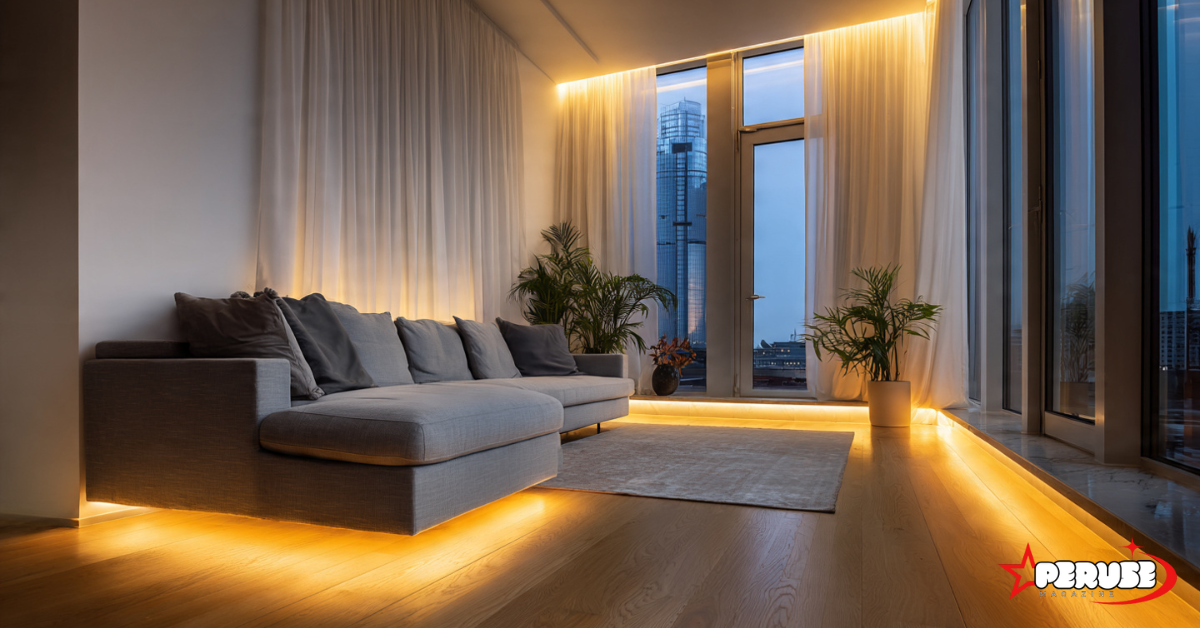
What if your floor could glow like a boutique hotel corridor, and your electricity bill actually went down? That’s not a design fantasy reserved for million-pound penthouses or futuristic showhomes. It’s the reality of LED skirting baseboard lighting, the cleverest lighting trend to hit Pinterest boards and electrician WhatsApp groups since Edison gave up on the lightbulb.
Most of us live with lighting that’s either too harsh (that one overhead bulb that makes you look like you’re in a police interrogation) or too dim (the floor lamp that casts shadows in all the wrong places). We scroll past those impossibly sleek London flats on Instagram, where walls seem to float and floors emit a soft, welcoming haze, thinking it must involve rewiring the entire house. Spoiler: it doesn’t. With an aluminium channel, a strip of LEDs, and an afternoon that you were probably going to spend watching reruns anyway, you can install this smart home upgrade even if you’re renting. Yes, really—there are non-permanent options that won’t cost you your deposit.
📦 Smart Home Info Box
Upgrade Type: Ambient Lighting & Smart Home Aesthetic
Best For: Renters, design lovers, tech-curious homeowners, families with young children
Budget Range: £45–£120 per room (depending on permanence and smart features)
Main Benefit: Architectural drama + safety lighting + energy savings in one sleek, renter-friendly package
Editor’s Tip: Start with a hallway or bedroom. It’s the easiest win and the most dramatic “before and after” for your Instagram followers.
What Is LED Skirting Baseboard and Why It’s the Coolest Lighting Trend of 2026
LED skirting baseboard lighting is essentially architectural jewellery for the junction where your wall meets your floor. Think of it as a low-level halo that makes your room look like it’s gently levitating. Technically, it’s an aluminium channel—usually between 8mm and 12mm deep—that houses an LED strip, topped with a diffuser that softens the light into a continuous glow. No polka dots of brightness. No visible wiring. Just a seamless, sophisticated wash of light that designers have been using in high-end hotels for years.
The magic happens at eye level, or rather, below eye level. Our brains are wired to find low, warm light calming. It’s why candlelight feels romantic and why overhead fluorescents feel like you’re being interrogated. LED baseboard lighting slots perfectly into the human-centric lighting movement that’s dominating 2026 design forecasts. It’s not just about seeing better; it’s about feeling better in your space.
I first spotted this trick in a friend’s renovated Manchester flat. She’d bodged it together with £40 of Amazon bits and a YouTube tutorial. The effect was so subtle yet so transformative that I spent the entire dinner party staring at her floor like a weirdo. Her plain white hallway now had the quiet confidence of a boutique hotel. She’d even synced it to her Philips Hue system so it faded on at sunset. “Took me three hours,” she shrugged, refilling my wine. “Easiest thing I’ve done since I learned how to plant succulents.”
The Science Behind That Instagram-Worthy Glow
Here’s where we get slightly nerdy but in a useful way. The reason LED skirting looks so expensive is down to two things: diffusion and colour temperature. The diffuser usually made of opal polycarbonate is the real hero. It scatters the light from individual LED diodes so you don’t see those tell-tale hot spots. Without it, your fancy floor lighting looks like a string of Christmas lights that’s been hammered flat.
Then there’s the colour rendering index (CRI). For your home, aim for a CRI above 90. It means colours look true, not washed out. Your warm walnut floor stays walnut; your grey sofa doesn’t turn lilac. The other number to care about is Kelvin (K). 2700K is your cozy, fireside glow, perfect for living rooms and bedrooms. 3000K is crisper, modern, great for kitchens. Anything above 4000K belongs in a hospital or an office block, not under your skirting board.
Light at floor level also plays tricks with perception. It bounces off surfaces in a way that makes ceilings feel higher and walls feel farther apart. It’s the interior design equivalent of vertical stripes, except it actually works.
5 Reasons Your Home Needs LED Baseboard Lighting Right Now
Still on the fence? Let me walk you through the five genuine life upgrades this single project delivers. These aren’t marketing fluff; they’re the reasons my own hallway now glows like a five-star spa.
1. Ambiance That Adapts to Your Mood
Picture this: it’s 6 a.m., you’re padding to the kitchen for coffee. Instead of blinding yourself with the main light or stumbling in the dark, your skirting lights fade on at 10% brightness warm, golden, just enough to see the kettle. Or it’s movie night; the overhead lights are off, but the skirting casts a gentle pool of light so you can still find the popcorn bowl. The digital dimmer that comes with most decent LED kits means you’re not stuck with “on” or “off.” You’re designing light scenes. It’s like having a lighting director for your life.
2. Safety Without the Ugly Nightlight
My neighbour installed these after her mother tripped on the stairs during a midnight loo run. The low-level glow acts as a modern nightlight, chic enough for grown-ups, functional enough for toddlers and elderly parents. In hallways and on staircases, it’s a game-changer. You see the step edge without resorting to those plug-in lights that look like they belong in a child’s bedroom. The LEDs run cool to the touch, so even if little fingers get curious, there’s no burn risk.
3. Architectural Drama on a DIY Budget
Here’s the secret designers charge thousands for: layering light. Overhead pendants, table lamps, floor lights—each adds a dimension. Skirting lighting adds the final layer that makes a room feel finished. It creates a floating effect, especially against painted walls. My own hallway, which is about as architecturally interesting as a cereal box, now looks like it was sketched by someone who owns a Dieter Rams chair. The best part? You achieve this with a £45 kit from your local DIY shop, not a £5,000 lighting design consultation.
4. Energy Bills That Make You Smile
Let’s talk numbers, because your smart meter will thank you. A typical 5-metre LED strip uses about 24 watts. That’s less than your phone charger. Run it for six hours a day, and you’re looking at roughly £3 a year in electricity. Compare that to the 200-watt guzzler of a floor lamp or the 60-watt bulb you leave on in the hallway. LEDs also last. A decent COB (chip-on-board) strip will run for 50,000 hours. That’s 17 years if you use it eight hours a day. You’ll redecorate twice before you replace the strip.
5. Future-Proof Tech That Wows Buyers
Even if you’re not selling, it’s nice to know you’re adding perceived value. Estate agents love buzzwords like “smart home ready.” When buyers walk into a hallway that automatically lights up as they enter, it feels luxurious, even if the tech behind it costs less than a takeaway curry. It’s the same principle as fresh flowers at a viewing: it suggests a home that’s been cared for, modernised, and ready for the future. My friend who installed this in her Manchester flat? She sold it six months later. The buyer specifically mentioned the lighting as a “standout feature.” She left the receipt for the LED kit on the side—£38.99 from Amazon.
Choosing Your Perfect LED Skirting Profile: The Renter vs. Owner Guide
This is where the project splits into two paths. Emma, our renter persona from Manchester, needs a completely different approach to Marcus, the homeowner in Toronto. Both can achieve the glow; the journey just looks different.
Emma’s Surface-Mount Solution: She uses adhesive-backed aluminium channels that stick directly on top of existing skirting boards. The profile is slim—about 8mm deep—so it doesn’t look clunky. When her lease ends, she heats the adhesive with a hairdryer, pops the channels off, and touches up any residue with a Magic Eraser. Damage? Minimal. Deposit return? Secure.
Marcus’s Recessed Luxury: He’s routing a shallow groove into his plasterboard so the channel sits flush. The result is invisible by day, magical by night. It’s more work—he’s spending a Saturday with a multitool and a dust mask—but the finish is seamless. He’ll never need to think about it again.
Decoding the Specs Without the Headache
Walking into a lighting shop or browsing online can feel like reading a different language. Here’s the cheat sheet:
- Channel Size: Match it to your LED strip width. Most strips are 10mm wide, so a 12mm channel gives you wiggle room. Too narrow and you’ll be forcing it; too wide and it rattles.
- Diffuser Types: Opal is your friend. It hides the dots and gives that expensive, even glow. Frosted is crisper but can show slight spotting if your LEDs are too bright. Clear is for industrial looks—avoid unless you’re going for a nightclub vibe.
- Colours: White channels disappear against white walls. Black makes a bold modern statement. Anodised silver works if you have chrome fixtures elsewhere.
- Flex Profiles: Got a curved wall? Flex profiles bend to a minimum 500mm radius. They’re pricier but essential for bay windows or feature walls.
Step-by-Step: Install LED Skirting Baseboard in One Afternoon
I’m not going to lie: the first time I did this, I made every mistake in the book. I measured once and cut twice (backwards). I stuck the LEDs in before testing them (they were faulty). I forgot to buy end caps, so dust started colonising the channel within a week. Learn from my chaos. This method works.
Shopping List: What You’ll Actually Need
Before you even think about opening TikTok for tutorial videos, gather your kit. I buy from LEDSupply.co.uk or Amazon’s German storefront (better quality control). You’ll need:
- Aluminium LED channel kit – includes channels, end caps, and mounting clips. I like the K忠 brand for surface mount and Klus for recessed.
- LED strip lights – COB strips are worth the extra £10; they’re dotless and smoother. Look for 24V, not 12V—less voltage drop over long runs.
- Power supply/driver – calculate your wattage (length of strip × watts per metre) and add 20% headroom.
- Measuring tape, hacksaw with fine-tooth blade, screwdriver
- 3M VHB tape – if you’re renting. This stuff holds bridges together; it’ll handle your skirting board.
- Optional but brilliant: Smart controller like Shelly Plus 1PM or a Govee Wi-Fi dimmer.
The Installation Story: From Box to Glow
1. Measure & Plan Like an Architect Map your route with painter’s tape. Avoid doorframes—they’re a faff. Measure each straight run, add 10% for mistakes, and sketch it. Mark where your power outlet is; the driver needs to be within 2 metres. If you’re doing multiple rooms, think about where you’ll hide the drivers. I put mine on top of kitchen cupboards and inside wardrobe ceilings.
2. Cut Channels, Not Corners Use a mitre box for 45-degree angles at corners. Dry-fit everything before you stick or screw. There’s something deeply satisfying about clicking the pieces together and seeing your route take shape. It’s like a very grown-up Lego set.
3. Mounting: The Renter vs. Owner Moment
- Surface mount: Wipe your skirting with isopropyl alcohol. Peel the VHB tape backing, press firmly for 30 seconds per foot. Walk away for an hour, let the adhesive cure.
- Recessed: Set your multitool to 12mm depth. Cut a channel, vacuum dust, dry-fit. Use silicone adhesive to bed the channel, then skim plaster over the top. Sand when dry.
4. Stick the LEDs This is the moment of truth. Peel the backing as you go don’t let the adhesive collect dust. Press firmly, especially at corners. The strip should sit flush in the channel base, not float.
5. Add the Diffuser Start at one end and snap it in with your thumbs. You’ll hear a satisfying click. If it’s tight, run a hairdryer along it for 20 seconds to soften the plastic.
6. Wire It Up Connect the strip ends to the driver. Most use simple screw terminals no soldering. Hide the driver behind furniture or in a cupboard. Plug it in.
7. Test & Paint Power on. Do a little dance when it works. If you’ve surface-mounted, paint the channel to match your walls. Use a small foam roller for a smooth finish.
Pro Tips to Avoid Rookie Mistakes
- Never bend LED strips sharply. The copper traces break. Use flex profiles or solderless connectors for corners.
- Leave a 5mm gap at corners for thermal expansion. Aluminium expands when warm; your diffuser will buckle if it’s too tight.
- Test everything before the diffuser goes on. I cannot stress this enough. Faulty LEDs are rare but exist. Check them while you can still peel them off.
- Label your wires. If you’re running multiple zones, a simple piece of tape marked “hallway” or “bedroom” saves confusion later.
Budget Breakdown: Get the Look for Under £50
Let’s talk real numbers, because I know you’re wondering if this is another “£30 project that somehow costs £300.”
The Absolute Basics (Renter-Friendly):
- 5m aluminium channel kit with opal diffuser: £15 (Amazon Basics or Lunix)
- 5m 24V COB LED strip, 2700K: £20 (Hitlights or Pautix)
- 24V 60W driver: £10 (Hitlights)
- Total: £45 (plus £3 for a decent hacksaw blade)
The Smart Upgrade: Add a Shelly Plus 1PM Wi-Fi controller: £15
Total: £60 for voice control and app scheduling
The Permanent Luxury:
- 5m plaster-in channel: £40 (Klus B1928)
- Premium COB strip with CRI>95: £35
- Mean Well driver: £25
- Smart controller: £15
- Total: £115 for a seamless, invisible finish
The Renter Hack: Buy extra VHB tape. When you move, gently heat the channels with a hairdryer, slide a credit card behind, and peel. Fill any marks with a dab of filler. Take the kit to your next place. It’s the smart home equivalent of a removable wallpaper.
Troubleshooting: Why Your LED Skirting Isn’t Perfect (Yet)
My first attempt looked brilliant for three days. Then the diffuser started popping out at corners, and one section flickered like a haunted house. Here’s what I learned.
Uneven Glow or Dark Patches: The diffuser isn’t fully seated. Run your thumb along it, pressing firmly. If that fails, your LED strip is too close to the diffuser edge. You need at least 3mm clearance.
Flickering: Usually an underpowered driver. Check your wattage, if your strip draws 48W and your driver is 50W, it’s running at 96% capacity and will overheat. Get a 60W driver. Also check connections; loose wires cause havoc.
Visible Dots: You cheaped out and got standard LEDs instead of COB. Or your diffuser is frosted, not opal. Opal is milkier and hides sins better.
Channels Peeling Off: Surface prep fail. Skirting boards are dusty. Wipe with isopropyl alcohol, not just a damp cloth. For extra grip, sand lightly with 120-grit paper.
Colour Mismatch Between Rooms: Buy all your LED strips from the same batch. Manufacturing tolerances mean two strips marked “2700K” can look different. Check the CRI rating too, low CRI makes everything look muddy.
Smart Home Hacks: Voice Control Your Floor Lights
This is where the project graduates from “cool DIY” to “proper smart home.” You don’t need to be a coder or spend hundreds on a hub.
The Simple Route: Buy a smart plug with dimming, like the Govee Floor Lamp Dimmer Plug, and plug your driver into it. You get on/off and dimming via an app. Job done.
The Clever Route: Wire a Shelly Plus 1PM into the driver’s input cable. It’s a tiny Wi-Fi relay that lives in your wall socket box or behind the driver. You can flash it with Tasmota or use the native app to add it to Alexa, Google Home, or HomeKit. Now you can say, “Alexa, set hallway to 20%,” and it obeys.
Automation Ideas That Actually Work:
- Sunset routine: Lights fade on at 30% as the sun sets. No more walking into a dark house.
- Motion sensing: Add a cheap PIR sensor in the hallway. Lights pop on at 10% when you shamble to the bathroom at 3 a.m.
- Movie mode: Sync with your TV’s bias lighting. When the TV turns on, skirting dims to 15%.
- Away mode: Randomly flick lights on and off when you’re on holiday. Burglars hate it.
I’ve got mine set to “Gentle Wake Up” half an hour before my alarm, the bedroom skirting slowly brightens from 0% to 40%, mimicking sunrise. It’s the kindest way to leave sleep behind.
Eco Impact: Why LEDs in Your Skirting Save the Planet (and Your Wallet)
Let’s geek out on sustainability for a moment, because this is where LED skirting quietly excels.
The Stat That Matters: According to the Energy Saving Trust, LEDs use 75% less energy than halogen bulbs and last 25 times longer. But that’s just the beginning. Because skirting lighting is task-oriented, you use it instead of main lights, you’re not just swapping bulbs, you’re reducing total usage.
Real-World Maths: My hallway used to run a 60W pendant for four hours every evening. That’s 240Wh. Now, the skirting runs at 20W for the same period: 80Wh. That’s a 67% saving. Scale that across a year, and I’ve saved around £12, not earth-shattering, but it’s a free coffee a month. More importantly, it’s 58kg of CO2 I didn’t emit.
Heat Reduction: LEDs run cool. My old halogen floor lamp heated the corner of the living room like a tiny sun, nudging the thermostat higher in summer. The skirting doesn’t. Less AC use, lower bills.
The real eco-win is longevity. Cheap LEDs fail after a year. Decent COB strips last a decade. Buy once, install once, forget about it. That’s sustainable design in its purest form.
Editor’s Verdict: Is It Actually Worth It?
After installing this in three rooms, helping a friend do her hallway, and fielding questions from my mum’s book club, here’s my honest take.
The Pros: The aesthetic impact is disproportionate to the effort. It’s a £45 project that looks like a £2,000 lighting design. It’s genuinely useful—safety lighting, mood lighting, and nightlight in one. It’s energy-efficient enough that you’ll notice the difference. And it’s flexible: renters can do it, homeowners can go luxe, and everyone can add smart controls later.
The Cons: It’s not completely foolproof. If you rush the measuring, you’ll waste channels. If you skip surface prep, it’ll peel. The driver placement can be a puzzle—there’s always that one spot where you can’t hide it. And if you live in a period property with ornate Victorian skirting, this will look jarringly modern. Context matters.
Best For: Modern flats, new builds, basements, home cinemas, and long hallways. Anywhere you want clean lines and a futuristic vibe.
Skip If: You have toddlers who delight in pulling things apart, or you’re deeply attached to your traditional timber skirting. There are other ways to add low-level light—wall-mounted picture lights, for example.
Final Call: For under £50 and a Saturday afternoon, it’s the highest-impact upgrade you can DIY. Worth it? Absolutely—if you prep properly and buy decent kit. This isn’t a hack where you can cheap out on every component. Spend the extra £10 on opal diffusers and COB strips. Your eyeballs will thank you.
FAQs: The Questions Everyone Asks
Can I install LED skirting on carpeted walls?
No, but you can mount it on the skirting board just above the carpet line. The light still washes the wall above.
Will it work with existing skirting boards?
Yes. Surface-mount profiles sit on top. You might need to extend doorframes slightly with quadrant beading, but it’s a minor detail.
How do I hide the power driver?
Behind furniture, inside cupboards, on top of kitchen units, or in a false vent. Get creative. I’ve seen drivers hidden in hollowed-out books on a shelf.
Is it safe around kids and pets?
The LEDs are low-voltage (12V or 24V), so shock risk is minimal. The real danger is curious fingers pulling the strip. Secure cables with clips and use end caps.
Can I cut LED strips to length?
Only at the marked cutting points—usually every 50mm or 100mm. Cutting elsewhere breaks the circuit. Measure twice, cut once, swear never to do it wrong again.
What colour temperature is best?
2700K for cosy living spaces, 3000K for modern kitchens, 4000K only for utility rooms. Stick to 2700K unless you have a very specific reason not to.
Small Upgrades, Big Comfort: The Future of Living Starts at Home
We spend so much time thinking about the big renovations the kitchen extensions, the loft conversions that we forget the power of small, clever changes. LED skirting baseboard lighting is the definition of a smart upgrade: low cost, high impact, and genuinely useful every single day. It’s the kind of project that makes you look at your home differently, noticing how light moves and how a gentle glow can turn a functional hallway into a calming transition space.
Would you invest in a full smart home setup, or do simple upgrades like this make your space feel just right? For me, it’s the latter. The beauty of LED skirting is that it scales with your ambition. Start with a simple £45 kit and a switch. Add voice control later. Sync it to your sunrise routine when you’re ready. The future of living doesn’t have to be complicated. Sometimes, it starts with a glow at your feet.