

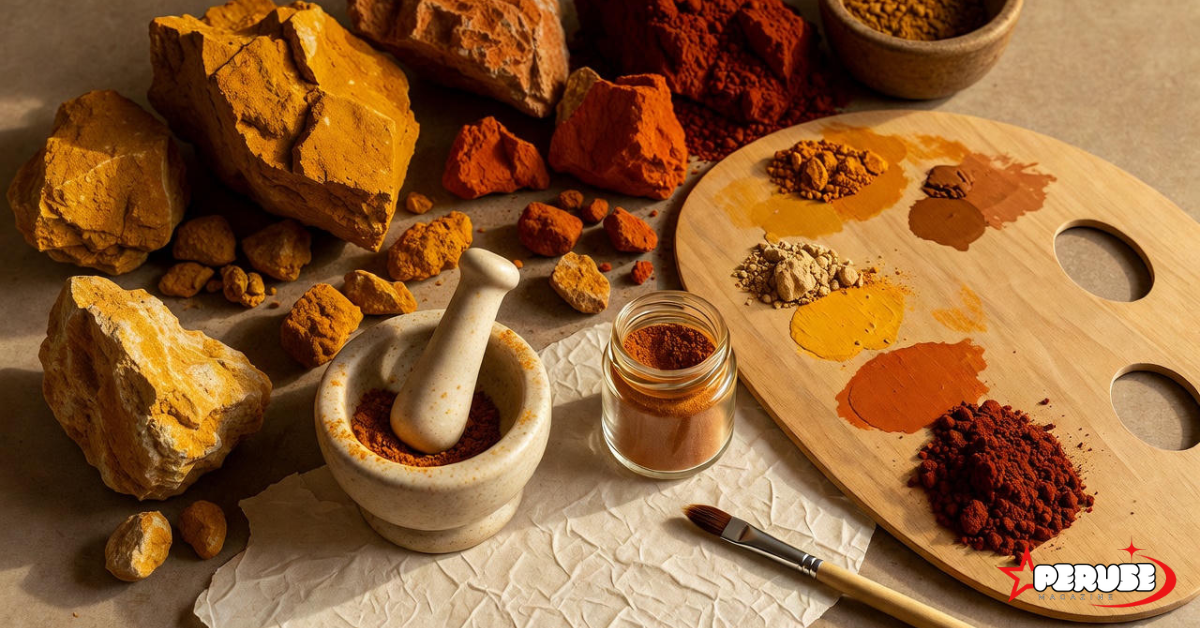
If you’ve ever handled raw earth that stains your fingers a deep, rusty yellow, you’ve touched ochre. As someone who’s spent years grinding pigments in the studio and sourcing materials from geological sites, I can tell you ochre is far more than a simple color—it’s a material that connects us to 300,000 years of human creative expression. This natural earth pigment, composed primarily of iron oxide and clay, forms the foundation of our earliest artistic traditions and remains indispensable in contemporary art practice.
What Is Ochre? Defining the Natural Earth Pigment
Ochre isn’t a single substance but a family of natural earth pigments ranging from pale yellow to deep reddish-brown. The term describes any clay-based material containing hydrated iron oxide that produces color when ground. When you crush a piece of yellow earth between your fingers and it yields a smooth, buttery paste, you’re experiencing ochre in its most elemental form.
Scientific Composition and Chemical Properties
The primary coloring agent in ochre is iron(III) oxide-hydroxide, known as limonite in its yellow form. This chemical structure contains substantial water molecules within its crystal lattice—despite feeling completely dry to the touch. When you examine ochre under magnification, you’ll see a complex mixture of silica, aluminum compounds, and clay minerals bound together by these iron oxides.
The ratio of ferric oxide to clay determines both color intensity and pigment quality. High-quality ochre contains roughly 20% iron oxide, though this varies dramatically by source. I’ve tested samples from French quarries that contain nearly 30% iron content, producing exceptionally vibrant pigments, while materials from certain UK sites contain less than 10%, resulting in weaker, chalkier colors.
Natural Formation Process and Geographic Distribution
Ochre forms through the weathering of iron-rich rocks over millennia. When iron-bearing minerals like pyrite or magnetite oxidize in the presence of water and oxygen, they slowly transform into hydrated iron oxides. This process creates layered sedimentary deposits that accumulate in specific geological contexts—typically in stratified rocks, alluvial deposits, and ancient lake beds.
You’ll find significant ochre deposits across Australia (particularly in the Western Desert), the Luberon region of France, Tuscany in Italy, and parts of the American Southwest. Each location produces distinct characteristics. The ochre from Sienna, Italy, contains traces of manganese that create warmer, more complex browns than the cleaner yellows from Provence.
Etymology: Tracing “Ochre” from Greek Ochros
The word “ochre” entered English in the 15th century through Old French ocre, but its roots stretch back to Ancient Greek ὠχρός (ōkhrós), meaning “pale yellow.” This etymological history reveals something important: the original concept of ochre centered on its yellow manifestation, not the broader color family we recognize today.
When you encounter the alternate spelling “ocher” (primarily American English), you’re seeing the same linguistic evolution take a slightly different path. Both spellings are correct, though “ochre” remains the international standard in art and archaeological literature.
The Color Science Behind Ochre Variations
Understanding why ochre shifts from yellow to red to brown requires examining the molecular behavior of iron compounds under different conditions. These variations aren’t arbitrary—they follow predictable chemical transformations that any artist can learn to anticipate.
Iron Oxide Chemistry: Limonite and Hematite Explained
Limonite, the hydrated iron oxide in yellow ochre, contains water molecules within its structure. When you heat this material to approximately 300°C, a chemical reaction called dehydration occurs—the water molecules escape, leaving behind anhydrous iron oxide, or hematite. This transformation explains why yellow ochre becomes red ochre through simple heating.
Hematite’s crystal structure absorbs different wavelengths of light, reflecting the red-orange portion of the spectrum rather than yellow. I’ve demonstrated this transformation in my studio by heating raw yellow ochre in a small kiln—watching the color shift from ochre-yellow to a deep, rich red over several hours provides tangible proof of this chemical principle.
Hydrated vs. Anhydrous Forms and Color Impact
The distinction between hydrated and anhydrous states determines not just color but also paint handling properties. Hydrated limonite creates a smoother, more buttery paint that disperses easily in oil or acrylic binders. Anhydrous hematite produces a stiffer, more granular texture that some artists prefer for creating textural effects.
In molecular biology, this hydration state has even led to a colloquial usage— researchers refer to the stop codon sequence “UAA” as “ochre” due to its historical color-coding in laboratory settings. While unrelated to pigment chemistry, this scientific borrowing demonstrates ochre’s deep integration into our cultural understanding of color.
Role of Manganese Dioxide and Secondary Minerals
When manganese dioxide infiltrates ochre deposits, the color shifts toward brown. Sienna contains less than 5% manganese oxide, creating its characteristic yellow-brown hue. Umber, with 5-20% manganese content, approaches deep chocolate tones. These aren’t contaminants—they’re essential components that define specific historical pigments.
Additional minerals like barite (barium sulfate) or gypsum can appear in ochre deposits, affecting opacity and tinting strength. I’ve found that ochres with higher silica content produce more transparent glazes, while those with additional clay create opaque, coverage-oriented paints.
Complete Color Spectrum: Yellow to Red to Purple Brown
The full ochre family includes:
- Yellow ochre: Clean, golden hues from pure limonite
- Red ochre: Rusty reds from hematite-dominant compositions
- Purple ochre: A rare variation where larger particle sizes diffract light differently, creating violet tones chemically identical to red ochre but visually distinct
- Brown ochre: Rich earth tones from goethite and lepidocrocite mixtures
Major Types of Ochre Pigments
Each ochre variant brings distinct working properties to the artist’s palette. Understanding these differences allows you to select the right pigment for your specific artistic goals.
Yellow Ochre: Gold Ochre Properties and Artistic Uses
Yellow ochre, sometimes called gold ochre, forms the workhorse of any earth-based palette. It mixes cleanly with blues to create naturalistic greens, with reds to make warm oranges, and with whites to produce delicate cream tones. In oil painting, its moderate drying time and excellent permanence make it ideal for underpainting and glazing alike.
The pigment’s natural transparency when thinned allows for luminous layering effects. When I need to create the illusion of sunlight filtering through leaves, yellow ochre provides the perfect foundation—transparent enough to let underlayers show through, yet warm enough to suggest natural light.
Red Ochre: Hematite-Based Pigment and Historical Symbolism
Red ochre’s connection to blood and earth made it central to ancient rituals worldwide. Archaeologists have found it in burial contexts across every continent, often applied directly to bones or grave goods. This pigment contains hematite in its anhydrous form, creating colors from bright rust to deep maroon depending on particle size and purity.
In Renaissance painting, red ochre appears in flesh tones, drapery studies, and architectural elements. Giorgio Vasari’s frescoes in Florence’s Hall of 500 demonstrate the pigment’s exceptional permanence—after 450 years, these earth-based colors remain vibrant while many contemporary pigments have faded completely.
Purple Ochre: Rare Particle Size Diffraction Phenomenon
Purple ochre represents one of nature’s optical curiosities. Chemically identical to red ochre—pure hematite—it appears purple due to larger average particle sizes that diffract light differently. This phenomenon, confirmed through electron microscopy studies, shows how physical structure alone can alter color perception.
Brown Ochre: Goethite and Lepidocrocite Composition
Brown ochre contains goethite (α-FeO(OH)), a hydrated iron oxide with a different crystal structure than limonite. This creates deeper, more neutral browns essential for naturalistic painting. When you need to paint tree bark, weathered wood, or stone, brown ochre provides an authenticity that synthetic browns rarely match.
Burnt Ochre: Heat-Induced Dehydration Transformation
The process of burning ochre—heating it in a kiln or even in a metal pan over a fire—transforms yellow to red through controlled dehydration. This technique, practiced for millennia, allows artists to create custom color temperatures from a single raw material. The resulting burnt ochre offers a transparency and warmth that’s difficult to replicate with tube paints.
Regional and Historic Ochre Varieties
Geography determines ochre character as much as chemistry. The minerals present in local geology create regionally distinctive pigments that have defined entire schools of painting.
Sienna and Umbria: Italian Earth Pigments Defined
Raw sienna, named for Siena, Italy, contains enough manganese to create warm, rich browns while maintaining its yellow character. Burnt sienna—raw sienna heated until it reddens—provides one of the most useful colors in any palette. Similarly, umber from Italy’s Umbria region contains higher manganese concentrations, producing deep, cool browns essential for creating depth in shadows.
Spanish Red and Original Naples Yellow Context
Spanish Red ochre, historically imported from the Iberian Peninsula, offered exceptional purity and color strength. Naples Yellow, though historically containing toxic lead antimonate, has natural ochre-based substitutes that mimic its warm, slightly greenish-yellow character without the health risks.
Indigenous Australian Ochre Traditions and Trade Routes
Australian Aboriginal cultures elevated ochre to sacred status, using it in ceremonies, body painting, and rock art for at least 65,000 years. Trade routes spanning thousands of miles distributed specific ochres—some more prized than others—between tribal groups. These “ochre highways” parallel the silk roads in their economic and cultural importance, connecting distant communities through shared materials.
Ochre in Archaeology and Human History
The archaeological record demonstrates ochre’s unique role in human cognitive development. Its use predates modern humans, appearing in Homo erectus sites 300,000 years ago.
300,000 Years of Documented Human Use
The earliest ochre processing tools—grindstones and hammerstones—appear consistently across African archaeological sites. These aren’t random findings; they represent deliberate pigment production, indicating symbolic thought and communication abilities in our earliest ancestors. The sheer quantity of ochre at some sites suggests organized manufacturing and trade long before agriculture.
Aboriginal Australian Art: 65,000 Years of Cultural Expression
In Australia, ochre enabled visual storytelling without written language. Concentric circles might represent waterholes, U-shapes denote people sitting, and straight lines map travel routes. These symbols, rendered in locally sourced ochres, created enduring records of Dreamtime stories, hunting grounds, and ceremonial knowledge. Many paintings remain visible today, their permanence testament to both the artists’ skill and the pigment’s durability.
Ancient Phoenician Burial Rituals and Red Ochre Symbolism
Phoenician burial sites contain extraordinary quantities of red ochre applied to bones, skulls, and grave goods. This practice reflected deep symbolic meaning—red ochre represented blood, life force, and the promise of rebirth. Quality and quantity of ochre in a burial indicated social status, with elite individuals interred with finely ground, vibrantly colored pigments applied in complex patterns.
Renaissance Masterworks: From Rembrandt to Pompeii Frescoes
Rembrandt’s limited palette—often just ochre, umber, white, and black—demonstrates the pigment’s versatility. His warm, glowing flesh tones rely on subtle mixtures of yellow and red ochre. Similarly, Pompeii’s frescoes retain their ochre-based colors after nearly 2,000 years, while many brighter mineral pigments have degraded completely. This permanence explains why ochre remained the backbone of professional painting until the 19th century.
Modern Applications of Ochre
Despite synthetic alternatives, natural ochre maintains relevance in contemporary creative fields. Its unique properties—and cultural authenticity—keep it irreplaceable for many applications.
Ochre in Contemporary Fine Art Practice
Many professional artists still grind their own ochre, seeking colors impossible to obtain from tube paints. The subtle variations in particle size, the slight grittiness that creates texture, and the knowledge that you’re working with the same materials as prehistoric artists all contribute to ochre’s ongoing appeal. In my own landscape painting, nothing matches the natural harmony of earth colors created from actual earth.
Digital Design Standards: The Ochre Hex Code #CC7722
For digital work, the standardized ochre hex code is #CC7722—80% red, 47% green, 13% blue in RGB values. This represents a medium ochre, though designers should understand that natural ochre varies dramatically. The CMYK breakdown of 0% cyan, 42% magenta, 83% yellow, and 20% black provides a starting point for print applications, though matching natural pigment requires custom color profiling.
Biophilic Interior Design and Earth-Based Color Palettes
The biophilic design movement—integrating natural elements into built environments—has revived interest in ochre-based color schemes. Ochre connects interiors to natural landscapes, creating psychological benefits through color association. When paired with forest greens (#2E6F40) or slate blues (#557C99), ochre provides warmth without overwhelming, mimicking natural ecosystems.
Conservation Science: Restoring Heritage with Natural Pigments
Museum conservators often match historical ochre colors using natural pigments rather than modern synthetics. The subtle variations in particle shape and mineral content affect how light interacts with the surface, and synthetic alternatives can look jarringly uniform when placed next to original materials. Analyzing ochre samples from artworks allows researchers to sometimes identify the geographic origin of the pigment, providing clues about ancient trade routes.
Working with Ochre: A Practical Artist’s Guide
Whether you’re grinding raw earth or working with tube paint, understanding ochre’s physical properties improves your results dramatically.
Grinding Raw Ochre into Fine Pigment Powder
Raw ochre requires careful processing. After collecting, dry the material completely—any remaining moisture causes clumping during grinding. Use a mortar and pestle to break down chunks, then transfer to a muller and glass plate with a small amount of water to create a smooth dispersion. The goal is uniform particle size; uneven grinding produces streaky paint with inconsistent color.
I’ve found that processing ochre in small batches yields better results. Large quantities generate heat through friction, which can prematurely dehydrate limonite, shifting yellows toward red mid-process.
Mixing Ochre with Oil, Acrylic, and Watercolor Binders
For oil painting, mix ochre powder with refined linseed oil to create a stiff paste, then gradually thin to desired consistency. Ochre’s natural absorbency requires more oil than modern synthetic pigments—plan for approximately 30% more binder by volume.
In acrylics, use a matte medium rather than gloss to maintain the earthy character. For watercolor, simply add gum arabic solution to the pigment dispersion. The natural starch content in some clay-based ochres helps the pigment disperse cleanly in water-based mediums.
Lightfastness Ratings and Permanence Testing
Natural ochres possess exceptional lightfastness—most rating “Excellent” (8) on the Blue Wool Scale. To test permanence yourself, paint a swatch on paper and expose half to direct sunlight for three months, keeping the other half covered. With genuine ochre, you’ll see almost no fading. This permanence, verified through centuries of use, makes ochre invaluable for work intended to last generations.
Safety Protocols and Handling Best Practices
Natural ochre is non-toxic and environmentally benign—artists have handled it safely for millennia. However, if you’re grinding raw material, wear a dust mask to avoid inhaling silica particles. Always source ochre from areas free of industrial contamination, as heavy metals or asbestos can occasionally occur in natural deposits.
Clean tools with soap and water rather than solvents when possible. Ochre’s water-mixable nature makes studio cleanup simple and reduces environmental impact compared to chemical-heavy synthetic pigments.
Natural Ochre vs. Synthetic Alternatives
Modern paint manufacturers offer convincing synthetic replacements under names like “Mars Yellow” or “Synthetic Iron Oxide.” These present genuine advantages but also trade-offs any serious artist should understand.
Mars Pigments: Modern Chemical Production Methods
Mars colors are manufactured by precipitating synthetic iron oxide rather than refining natural earth. This process creates perfectly uniform particles and consistent color batches—advantages for commercial applications requiring color matching. However, that uniformity can appear lifeless compared to natural ochre’s subtle variations.
Color Accuracy and Performance Comparison Testing
Side-by-side tests show subtle differences. Natural ochre creates more complex color mixtures—mixing with ultramarine produces nuanced greens with natural depth, while synthetic ochre mixtures can appear flat. The natural pigment’s slight particle variation creates microscopic light scattering that synthetic uniformity eliminates.
Environmental Impact and Toxicity Considerations
Ironically, synthetic production carries a larger environmental footprint than harvesting natural ochre. Mining and chemical processing for Mars pigments requires substantial energy, while ochre requires only grinding and purification. Natural ochre contains no toxic additives, while some synthetic pigments include stabilizers and dispersants of unknown long-term safety.
Cost Analysis and Accessibility for Artists
Professional-grade natural ochre costs 20-40% more than synthetic alternatives. However, the price difference reflects labor-intensive processing and smaller-scale production. For artists producing work for sale or exhibition, this cost increase is minimal compared to the benefits of authenticity and permanence.
Sourcing and Identifying Quality Ochre
Not all ochre is equal. Learning to assess quality saves money and frustration.
Ethical Harvesting of Natural Earth Pigments
If collecting ochre yourself, research land ownership and protected areas first. Many culturally significant sites prohibit collection. Seek deposits on public lands where geological collection is permitted. Take only small amounts for personal use, leaving the site undisturbed.
Geographic Quality Indicators by Source Region
French ochre from the Luberon Valley consistently shows high purity and excellent color strength. Italian earth pigments offer subtle variations based on specific quarries. Australian ochres vary dramatically—some deposits produce incredibly fine particles perfect for watercolor, while others yield coarser material better suited for texture building.
Reputable Suppliers and Professional Art Material Brands
Several manufacturers maintain relationships with specific quarries, providing reliable quality. Look for suppliers who specify geographic origin and provide pigment analysis data. Kremer, Natural Pigments, and Sinopia offer excellent natural ochres with documented sourcing.
Authenticity Verification and Adulteration Detection
Adulterated ochre—cut with chalk, clay, or synthetic extenders—handles poorly and lacks concentration. Test by mixing a small amount with water; pure ochre creates a smooth, homogenous paste without settling quickly. Adulterated samples separate rapidly or feel gritty. The color concentration in pure ochre is unmistakable—a small amount creates strong tinting power.
Key Takeaways for Artists, Designers, and Cultural Historians
Ochre represents humanity’s longest-running relationship with color. Its chemical stability, natural abundance, and subtle beauty have made it indispensable across millennia and continents. For contemporary artists, understanding ochre means connecting to this deep history while gaining practical skills for creating lasting, meaningful work.
Designers working with ochre tap into psychological associations with earth and permanence, creating spaces that feel grounded and authentic. Cultural historians studying ochre distribution trace ancient trade routes and symbolic systems, revealing connections between distant peoples.
The pigment’s greatest lesson is perhaps this: the most permanent, most beautiful colors often come not from complex chemical factories but from the patient work of geology and time. In an age of disposable digital color, ochre reminds us that some materials—and some traditions—earn their permanence through sheer reliability and depth.
Frequently Asked Questions
Is natural ochre pigment toxic or safe for indoor use?
Natural ochre is completely safe and non-toxic. Artists and craftspeople have used it continuously for hundreds of thousands of years without health issues. Unlike historical pigments containing lead, mercury, or arsenic, ochre is simply refined earth. The only safety consideration involves airborne silica when grinding raw material—wear a dust mask during processing, but the finished paint poses no risk even in poorly ventilated studios.
What distinguishes ochre from ocher in spelling and usage?
“Ochre” and “ocher” are variant spellings of the same word, with “ochre” being the international standard in art, archaeology, and scientific literature. “Ocher” appears primarily in American English dictionaries but is rarely used by professionals. Both refer to identical materials, but “ochre” is the spelling you’ll encounter in pigment catalogs, museum labels, and academic publications.
How does burnt ochre differ chemically from raw yellow ochre?
Burnt ochre begins as yellow ochre (hydrated iron oxide, or limonite). When heated to 300-400°C, the water molecules within the crystal structure evaporate through dehydration, converting limonite to hematite—anhydrous iron oxide. This chemical change fundamentally alters which light wavelengths are absorbed and reflected, shifting the color from yellow to red while maintaining the same iron content. The process is irreversible and creates a pigment with different working properties and mixing behaviors.
Which modern colors complement ochre in digital and physical design?
Ochre’s earthy warmth pairs beautifully with complementary colors that enhance its natural qualities. In digital design, try combining #CC7722 ochre with forest greens (#2E6F40) for nature-inspired palettes, slate blues (#557C99) for sophisticated contrast, or deep burgundy (#660033) for rich, warm interiors. For physical painting, ochre works harmoniously with ultramarine blue, raw umber, and Payne’s gray. Always test combinations at the scale you’ll use them, as ochre’s strong earthiness can dominate delicate mixtures.
Can artists ethically source and process their own ochre pigment?
Yes, with careful research and responsible practices. Identify public lands where geological collection is permitted, avoiding culturally significant sites or private property. Collect small amounts—enough for personal projects, not commercial resale. Process using simple hand tools: break down dried material with a mortar and pestle, then grind with a muller and water until smooth. Screen through fine mesh to remove sand particles. Ethical sourcing respects both the environment and indigenous cultural connections to these materials.
What archaeological evidence explains ochre’s role in ancient burial ceremonies?
Archaeologists have excavated multiple lines of evidence: ochre-stained human remains showing direct application to bones, grave goods coated in pigment, grinding tools with ochre residue, and even containers still holding powdered pigment. At Qafzeh Cave in Israel, 92,000-year-old shells containing ochre show it was stored and valued. The pigment’s red color symbolically linked to blood and life force across cultures, while its quantity and quality in burials indicated social status. This pattern appears from African Middle Stone Age sites to Phoenician cemeteries, demonstrating ochre’s universal symbolic power.