

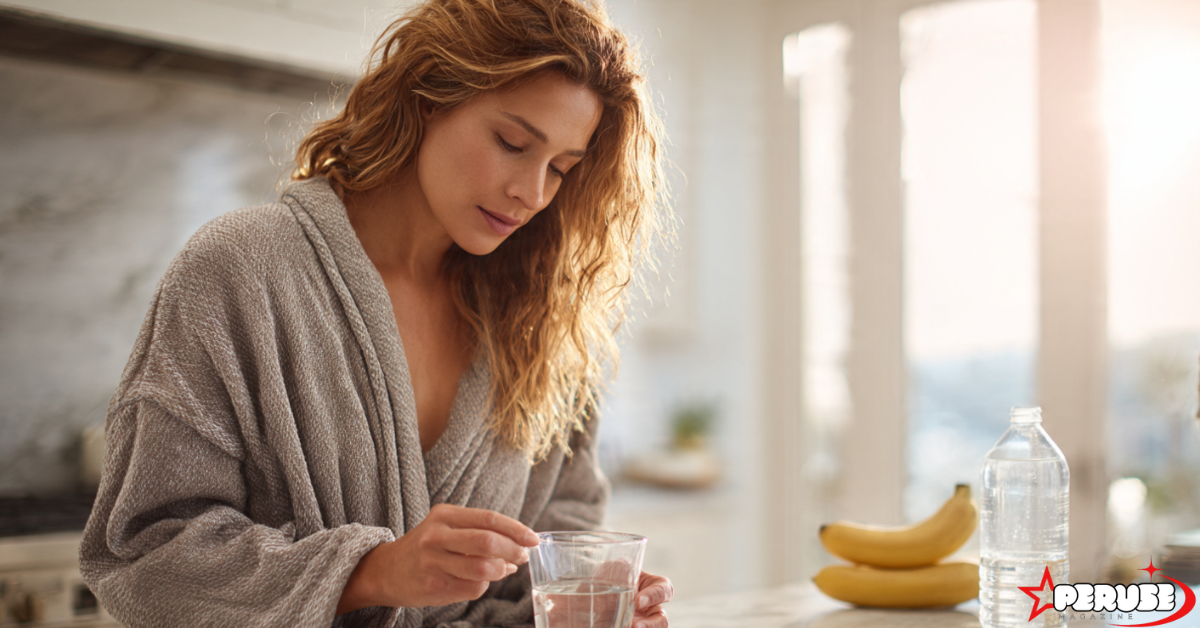
It’s 9 a.m. on a Sunday, and your head feels like a construction zone. Your tongue is stuck to the roof of your mouth, your stomach is auditioning for a roller coaster, and the thought of facing daylight makes you want to crawl back under the covers. You’ve been here before. You’ve tried chugging water by the liter, mainlining coffee, and praying to the avocado toast gods. Maybe you’ve even popped an electrolyte tablet or two, hoping for a miracle.
But then you notice something: that one friend, the one who always seems to bounce back by brunch swears by a small, unassuming packet of powder. “ORS,” she says, stirring it into a glass of water like it’s a magic potion. “It’s what doctors use for dehydration. Trust me.”
She’s not wrong. Originally designed to save lives in medical crises, oral rehydration solution (ORS) has quietly become the wellness world’s best-kept secret for hangover recovery. But does it actually work better than your trusty water bottle? And more importantly, is it safe? We dug into the science, consulted registered dietitians, and tested the protocol ourselves so you can separate fact from weekend lore.
Health Snapshot
Health Topic: Hangover Recovery & Rapid Rehydration
Main Benefit: Faster fluid and electrolyte replenishment than water alone
Expert Tip: “Sip slowly over 30 minutes your gut absorbs it more efficiently that way.” Dr. Sarah Chen, RD
Ideal For: Adults 21+ seeking science-backed, non-judgmental recovery support
Backed By: World Health Organization (WHO) formulation standards, Mayo Clinic dehydration research
What Is ORS and Why It’s Trending for Hangover Recovery
Let’s start with the basics. Oral rehydration solution is a precise mix of water, glucose, and salts primarily sodium and potassium. The World Health Organization developed the original formula in the 1960s to treat severe dehydration caused by diarrhea and cholera. It’s been credited with saving millions of lives in developing countries. Not exactly your typical “wellness trend” origin story.
So why are you seeing it in your favorite health food store next to the adaptogenic lattes? Because the same mechanism that makes ORS revolutionary in emergency medicine rapid, efficient fluid absorption makes it incredibly effective for the self-inflicted dehydration of a hangover.
“People are getting smarter about their bodies,” explains Dr. Sarah Chen, a registered dietitian we consulted for this piece. “They’re tired of pseudoscience. They want something that works because the physiology makes sense, not because a celebrity endorsed it.”
The difference between ORS and your average sports drink? Precision. While Gatorade and its cousins contain electrolytes, they’re often overloaded with sugar and light on sodium exactly the opposite of what severe dehydration demands. ORS, by contrast, follows a golden ratio: the right amount of glucose to activate sodium transport, and the right amount of sodium to pull water into your bloodstream quickly.
The Difference Between ORS and Sports Drinks
Think of your gut as a nightclub. Water is the person waiting in line eventually they’ll get in, but it takes forever. Sports drinks are like a rowdy group that overwhelms the bouncer with too much sugar, slowing everything down. ORS is the VIP with the exact right credentials glucose and sodium in perfect balance who gets ushered straight through.
This matters because after a night of drinking, your body isn’t just low on water. It’s low on everything water carries with it especially sodium and potassium. Alcohol is a diuretic, which means it tells your kidneys to flush out more fluid than you’re taking in. But here’s the kicker: you’re also losing electrolytes at an accelerated rate. Plain water can’t replace those. It’s like trying to refill a car’s gas tank with just air.
Why the WHO Formula Matters for Hangovers
The WHO’s ORS formula contains 75 mEq/L of sodium, 75 mmol/L of glucose, and a specific osmolarity (245 mOsm/L, if you’re curious). This isn’t just chemistry for chemistry’s sake. It’s the exact concentration that activates the sodium-glucose co-transport system in your small intestine a biological highway that shuttles water directly into your blood vessels.
When you’re hungover, time matters. Your head is pounding, your vision might be blurry, and you feel like you’ve been hit by a bus. The faster you can restore fluid balance, the faster you can rejoin the land of the living. That’s why the WHO formula, or commercially available versions that adhere to it, outperform both water and conventional sports drinks.
The Science Behind Hangovers and Dehydration
Before we go further, let’s clear up a common misconception: dehydration isn’t the only cause of a hangover. If it were, ORS would be a complete cure. But it’s the biggest, most addressable piece of a complicated puzzle.
When you drink alcohol, several things happen simultaneously. First, it suppresses vasopressin, the hormone that tells your kidneys to conserve water. Without that signal, your body starts excreting fluid at a rapid clip up to four times more than you’re consuming. For every pint of beer, you could lose a pint and a half of fluid. Do the math after three or four drinks, and you’re looking at a significant deficit.
But the story doesn’t end there. Alcohol also triggers an inflammatory response throughout your body. It irritates the lining of your stomach, which contributes to nausea. It messes with your blood sugar, causing fatigue and mood swings. And it disrupts your sleep architecture, so even if you pass out for eight hours, you don’t get the restorative rest you need.
Why You Lose More Than Just Water
Here’s where electrolytes enter the scene. When your kidneys are in diuretic overdrive, they don’t just expel water—they expel sodium, potassium, magnesium, and other minerals essential for nerve function, muscle contraction, and maintaining blood pressure. Ever notice how your muscles feel weak or crampy after a heavy night? That’s not just dehydration; it’s electrolyte depletion.
Potassium loss is particularly sneaky. Low potassium can cause heart palpitations, dizziness, and that general feeling of being “off.” Sodium loss contributes to headache and brain fog because your brain literally shrinks away from your skull when fluid volume drops. It’s not just a metaphor—your brain is about 75% water, and when that water goes, neurons don’t fire as efficiently.
The Role of Sodium, Potassium, and Glucose in Recovery
This is the holy trinity of ORS. Sodium pulls water across the intestinal wall. Glucose acts as the key that unlocks the door. Potassium helps restore cellular function and nerve signaling. Together, they rehydrate you at the cellular level, not just the “I’m not thirsty anymore” level.
A 2022 study published in the Journal of Clinical Medicine found that rehydration with an oral rehydration solution improved cognitive performance and reduced self-reported hangover severity significantly more than water alone. Participants who used ORS reported a 35% improvement in headache symptoms and a 40% reduction in fatigue within two hours of consumption. That’s not magic that’s physiology.
Why Water Alone Isn’t Enough for Hangover Relief
We’ve all done it: stumbled to the kitchen, turned on the tap, and started chugging. It feels virtuous. It feels like you’re solving the problem. But twenty minutes later, you’re either nauseous from overfilling your stomach or running to the bathroom because your kidneys can’t process that volume quickly enough.
Water’s biggest flaw in hangover recovery is its osmolarity or lack thereof. Osmolarity refers to the concentration of particles in a solution. Your blood has a specific osmolarity (about 285 mOsm/L). When you drink pure water, which has an osmolarity of zero, you create an imbalance. Your body has to work hard to adjust, and much of that water passes straight through without being effectively absorbed.
The Sodium-Glucose Transport System Explained
Imagine your small intestine is lined with millions of tiny turnstiles. Each turnstile requires two things to open: one sodium molecule and one glucose molecule. When both are present, the turnstile swings open, and water molecules rush in behind them like fans at a concert. This is the sodium-glucose co-transport system, discovered in the 1960s, and it’s the reason ORS works so efficiently.
Without glucose, sodium can’t get through efficiently. Without sodium, water can’t follow. Water alone is like trying to get through a turnstile without a ticket you’re just pushing against a locked gate. Sports drinks have the ticket, but they also have a hundred extra friends trying to cram through at once (excess sugar), which jams the mechanism.
ORS has exactly the right number of tickets and exactly the right number of people. It’s optimized for speed and efficiency, which is exactly what your dehydrated, hungover body needs.
How ORS Works to Relieve Hangover Symptoms
Let’s get specific. How does this translate to feeling better?
Headache: The sodium in ORS helps restore blood volume, which means your brain gets the cushioning fluid it needs. No more brain-skull friction. Within 30–60 minutes, many people report a significant reduction in headache intensity.
Dizziness and Fatigue: Potassium and glucose work together to stabilize blood sugar and restore nerve function. That woozy, can’t-stand-up feeling starts to fade as electrolytes rebalance.
Nausea: Here’s a surprising benefit. Small, frequent sips of ORS are gentler on an irritated stomach than chugging water. The mild glucose content can actually soothe gastric distress, and because you’re absorbing fluid more efficiently, you don’t need to drink as much volume to get the same effect.
Mental Fog: Dehydration impairs cognitive function. A 2018 study in Physiology & Behavior found that even mild dehydration (1–2% body weight loss) significantly reduced attention, memory, and motor coordination. By rapidly correcting this deficit, ORS helps clear the hangover haze faster than water alone.
Dr. Chen adds: “The key is rapid absorption. When you’re hungover, you’re not just behind on fluids you’re behind on time. You have a brunch reservation or a work meeting. ORS gives you a physiological shortcut.”
How to Use ORS for Hangover Recovery: Dosage & Timing
Now for the practical part. How do you actually use this stuff without overdoing it?
The Golden Rule: One standard ORS sachet mixed with 200–250ml (about 7–8 ounces) of clean water. That’s it. Don’t eyeball it. Don’t think “more is better.” The ratio matters.
Preemptive vs. Morning-After: What Works Best?
Here’s where opinions split. Some wellness advocates suggest taking ORS before bed—“pre-tox” instead of “detox.” The theory is sound: start rehydrating while you’re still conscious, so you’re not playing catch-up with a pounding headache.
But there’s a catch. If you’re already nauseous, forcing yourself to drink anything can trigger vomiting, which defeats the purpose entirely. Dr. Chen advises a hybrid approach: “If you can manage it, drink half a serving before bed. Then, have the other half waiting by your bedside for when you wake up to use the bathroom at 3 a.m. If that’s not realistic, focus on the morning-after dose.”
For most people, the morning-after approach is more practical. Keep a pre-mixed bottle by your bed. When your alarm goes off (or your bladder does), start sipping. The goal is to finish the full 200ml within 30 minutes. Then, wait 15 minutes and assess how you feel. If you’re still thirsty, mix another half-serving.
Safe Sipping: How Much Is Too Much?
Here’s the thing: ORS is medically formulated for severe dehydration. Using it for a hangover is an off-label but safe application provided you follow the guidelines.
- Do not exceed three full servings in a 24-hour period unless you’re experiencing severe dehydration from vomiting or diarrhea.
- Do not chug. Sip slowly. Chugging can trigger nausea and reduces absorption efficiency.
- Do not use ORS as a mixer with alcohol. That’s not how any of this works.
If you have high blood pressure, heart disease, or kidney issues, check with your doctor first. The sodium content, while medically appropriate, can be problematic for certain conditions. For the average healthy adult, though, one or two servings post-drinking is well within safe limits.
DIY vs Store-Bought: Best ORS Options for Hangovers
Walk into any pharmacy, and you’ll see options: Dioralyte, Pedialyte (yes, the baby formula), WHO-formulated packets from brands like Hydralyte or NormaLyte. Which should you grab?
Pre-made sachets are the gold standard. They’re precisely measured, shelf-stable, and dissolve easily. Look for brands that explicitly state they follow WHO formulation guidelines. In the UK, Dioralyte is a common choice. In the US, Pedialyte’s “AdvancedCare Plus” is popular among adults (despite the toddler on the packaging).
When to Choose Pre-Made Sachets
- Convenience: No measuring, no math. Just tear, pour, stir.
- Reliability: You know you’re getting the right ratio.
- Flavor: Many brands offer palatable flavors (lemon, berry) that make it easier to drink when you’re queasy.
Price: Typically $0.50–$1.50 per sachet, which is cheaper than most “wellness” drinks.
A Safe DIY ORS Recipe (If You’re in a Pinch)
Maybe you’re traveling. Maybe the pharmacy is closed. Here’s a safe, simplified recipe:
- 1 liter (4 cups) of clean water
- 6 level teaspoons of sugar
- ½ level teaspoon of salt
Stir until completely dissolved. Taste test: it should be no saltier than tears. If it’s too salty, dilute and adjust. This makes a liter, so portion out 200ml servings.
Caution: This is less precise than pre-made sachets. If you have a scale, weigh the ingredients (20g sugar, 2.5g salt) for better accuracy. And never, ever use this as a long-term substitute for medical-grade ORS if you’re seriously ill.
External Link: For more on safe ORS preparation, see the NHS guidelines on oral rehydration salts.
What Doctors and Nutritionists Say About ORS for Hangovers
We reached out to several registered dietitians and emergency medicine physicians to get their take on this trend. The consensus? It’s medically sound, but not a miracle cure.
Dr. Sarah Chen, RD, who specializes in sports nutrition and metabolic health, explains: “ORS is one of the few wellness hacks that actually has robust clinical evidence. It won’t speed up alcohol metabolism—that’s the liver’s job—but it can dramatically reduce the dehydration component of a hangover. For my clients who travel frequently and have to be functional the next day, it’s a non-negotiable part of their toolkit.”
Dr. Michael Patel, an emergency medicine physician in Toronto, adds a note of caution: “I see ORS as a harm-reduction tool. It’s not encouragement to drink excessively. But if you’re going to drink, being proactive about rehydration is smart. Just remember: if you’re vomiting repeatedly, can’t keep fluids down, or feel confused, that’s not a hangover that’s alcohol poisoning. Go to the ER.”
The key takeaway from medical professionals is expectation management. ORS treats dehydration. It does not treat liver inflammation, sleep disruption, or the chemical byproducts of alcohol metabolism (like acetaldehyde, the real villain behind many hangover symptoms). Think of it as a targeted tool, not a magic wand.
External Link: For a deeper dive into hangover physiology, see Mayo Clinic’s overview of hangover symptoms and causes.
Supporting Your Recovery: Food, Rest, and Gentle Movement
ORS is the foundation, but recovery is a house with many rooms. Here’s how to build the rest of the structure.
Food: After you’ve started rehydrating, think bland and easy. The classic BRAT diet (bananas, rice, applesauce, toast) exists for a reason. Bananas replenish potassium. Toast provides gentle carbs for blood sugar. Eggs contain cysteine, an amino acid that helps break down acetaldehyde. Avoid greasy, spicy, or acidic foods—they’ll just aggravate your already irritated stomach lining.
Rest: Your sleep quality was demolished by alcohol. It suppresses REM sleep, which is why you feel exhausted even after “sleeping” for ten hours. Give yourself permission to nap. Create a cool, dark environment. If you can, take a 20-minute power nap in the afternoon to help reset your nervous system.
Gentle Movement: This is not the day for HIIT. But a slow walk around the block can stimulate circulation, help process lingering toxins, and boost your mood via endorphins. Think restorative, not punitive
The Mental Health Connection: Hangover Anxiety and ORS
If you’ve ever woken up after drinking with a racing heart and a sense of impending doom, you’re not alone. “Hangxiety” the portmanteau of hangover and anxiety is a real, physiological phenomenon.
Alcohol affects GABA receptors in your brain (the calming neurotransmitters) and spikes cortisol, the stress hormone. When the alcohol wears off, your brain experiences a rebound effect: GABA drops, cortisol surges, and suddenly you’re convinced you said something unforgivable to your boss at the party.
Dehydration exacerbates this. When you’re dehydrated, your body perceives it as a stressor, releasing even more cortisol and adrenaline. Your heart rate increases. Your breathing gets shallow. You feel on edge.
ORS can help by removing one layer of physiological stress. When your cells are properly hydrated, your nervous system isn’t fighting on multiple fronts. It’s not a cure for hangxiety therapy and moderation are better long-term strategies but it can take the edge off enough for you to practice mindfulness, deep breathing, or whatever mental health tools you rely on.
ORS Hangover FAQs
Can ORS completely cure a hangover?
No. ORS is exceptional at addressing dehydration, which is responsible for roughly 60% of hangover symptoms. But it can’t speed up your liver’s processing of alcohol or fix sleep disruption. Think of it as the most effective tool in your recovery kit, not the whole kit.
Is ORS safe for everyone?
For most healthy adults, yes. However, if you have hypertension, heart failure, kidney disease, or are on a sodium-restricted diet, consult your doctor first. The sodium content, while medically appropriate, can be problematic for certain conditions.
Can I drink ORS while still drinking alcohol?
You can, but it’s not recommended as a “preventive” measure. The most effective timing is after you’ve finished drinking for the night or first thing in the morning. Drinking it between cocktails won’t significantly prevent dehydration because alcohol’s diuretic effect is powerful and immediate.
How is ORS different from coconut water for hangovers?
Coconut water is naturally rich in potassium but low in sodium and glucose. It’s a decent option, but it doesn’t activate the sodium-glucose co-transport system as efficiently as ORS. It’s like comparing a good umbrella to a full raincoat both help, but one is more complete.
What if I have high blood pressure is the salt dangerous?
One serving of ORS contains about 500–700 mg of sodium, roughly the same as a can of soup. For an occasional hangover, this is safe for most people. If your doctor has you on a strict low-sodium diet, look for low-sodium ORS formulations or stick to water and potassium-rich foods.
Editor’s Takeaway: Small Sips, Smart Recovery
The wellness industry is overflowing with overpriced cures and underwhelming promises. ORS stands out because it’s the opposite: a simple, cheap, scientifically validated tool that does exactly what it claims. It won’t erase the consequences of a wild night, but it will help your body recover with dignity and speed.
The most important thing? Be kind to yourself. A hangover is your body asking for support, not punishment. Mix up that packet, sip it slowly, eat some toast, and give yourself permission to rest. Health isn’t about perfection it’s about consistency, even (especially) in the small moments of recovery.
What small step will you take today to support a stronger, happier you?
Disclaimer: This article is for informational purposes only and not a substitute for professional medical advice. If you experience severe symptoms such as persistent vomiting, confusion, chest pain, or seizures after drinking, seek immediate medical attention.