

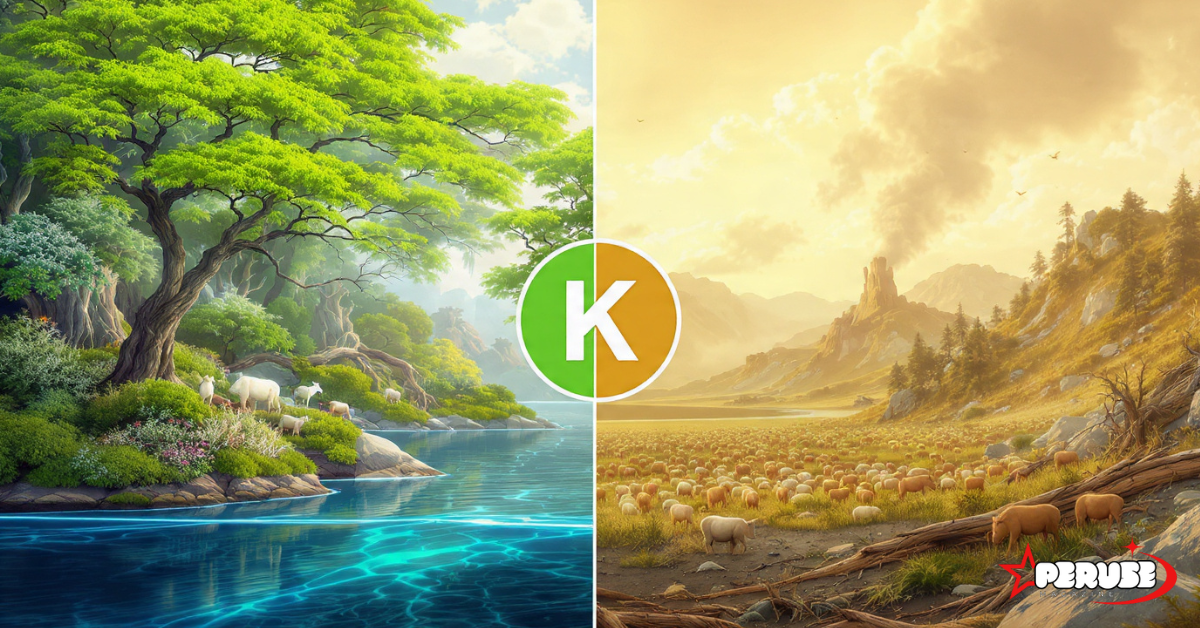
Every ecosystem has a breaking point. Whether it’s a pond that can only feed so many fish, a forest that can shelter a limited number of deer, or a planet struggling to support billions of humans, nature imposes boundaries on growth. Understanding these limits what scientists call carrying capacity is essential for anyone interested in biology, environmental science, or the future of human civilization.
This concept explains why populations crash after booms, why sustainable fishing quotas exist, and why environmentalists worry about humanity’s growing ecological footprint. Let’s explore what carrying capacity really means, how it works in practice, and why it matters for every species on Earth, including ours.
What Is Carrying Capacity? (Simple Definition)
Carrying Capacity Definition
Carrying capacity is the maximum number of individuals of a species that an environment can sustainably support indefinitely without degrading the habitat. In scientific notation, it’s represented by the symbol K.
The key word here is “sustainably.” An environment might temporarily support more individuals than its long-term capacity, but this comes at a cost. When a population exceeds carrying capacity, resources deplete, waste accumulates, and the ecosystem deteriorates. Eventually, something has to give—usually through starvation, disease, or mass die-off.
Think of it like a bus with limited seats. You might squeeze in a few extra standing passengers for a short trip, but you can’t operate that way forever without problems. Eventually, the ride becomes unsafe, uncomfortable, and unsustainable.
Why Carrying Capacity Matters
This concept serves as nature’s speed limit on population growth. Every species needs food, water, shelter, and space. When these resources become scarce, competition intensifies, birth rates drop, and death rates rise. Carrying capacity represents the equilibrium point where births and deaths balance out.
Understanding this limit helps wildlife managers set hunting quotas, helps farmers avoid overgrazing their land, and helps policymakers plan for sustainable resource use. Without this knowledge, we risk pushing ecosystems past their breaking point—sometimes with irreversible consequences.
Carrying Capacity in Biology & Ecology
The Science Behind Carrying Capacity
In population biology, carrying capacity emerges from the interaction between organisms and their environment. Several factors determine where this ceiling sits:
Density-dependent factors become more severe as populations grow:
- Competition for limited food and territory
- Increased predation pressure
- Higher disease transmission rates
- Accumulation of waste products
Density-independent factors affect populations regardless of size:
- Extreme weather events
- Natural disasters
- Habitat destruction
- Climate fluctuations
The interplay between these forces creates what ecologists call “environmental resistance”—the sum total of factors that prevent a population from growing indefinitely.
Carrying Capacity vs. Population Growth
Populations don’t grow in straight lines. Instead, they follow predictable patterns:
Exponential growth (J-curve) occurs when resources are abundant and reproduction happens rapidly. Think of bacteria multiplying in a petri dish, or rabbits colonizing a new island. Without limits, populations would grow forever.
Logistic growth (S-curve) describes what actually happens in nature. Growth starts slowly, accelerates, then slows as the population approaches carrying capacity. The curve flattens out near the K line, creating that characteristic S-shape.
In reality, most populations fluctuate around carrying capacity rather than settling at a steady number. A harsh winter might drop deer numbers below K, while a mild spring could push them above it temporarily. These oscillations are normal, but the long-term average tends to hover near the sustainable limit.
Real-World Carrying Capacity Examples
Wildlife & Animal Populations
Deer in North America provide a textbook case of carrying capacity dynamics. When predators like wolves were eliminated from many regions, deer populations exploded beyond what forests could support. The result? Overgrazing destroyed understory vegetation, starving deer ate bark off trees, and mass starvation events became common. Wildlife managers now use controlled hunting to keep deer numbers closer to sustainable levels.
Fish in a Pond illustrates the concept perfectly. Imagine a small pond that can support 100 fish based on available food and oxygen. Start with 20 fish, and they thrive. The population grows to 50, then 80. As numbers approach 100, competition intensifies. Growth slows. Eventually, the population stabilizes around that 100-fish limit. Add more fish, and water quality deteriorates. Food runs short. The population crashes back down.
Rabbits in a Garden show how quickly overshoot happens. A garden might naturally support 50 rabbits. After a mild winter with few predators, 70 rabbits survive to spring. They breed rapidly, depleting vegetation. By late summer, they’ve eaten everything green. Come winter, the population crashes to 30 rabbits—well below the original carrying capacity because the habitat was damaged.
Human & Historical Examples
The Irish Potato Famine (1845-1849) demonstrates how carrying capacity can suddenly drop. Ireland’s population had grown dependent on a single crop. When potato blight destroyed the harvest, the island’s carrying capacity plummeted overnight. Approximately one million people died, and another million emigrated. The environment hadn’t changed—the resource base had.
Cattle Overgrazing shows how exceeding carrying capacity degrades land. When ranchers stock too many cattle on rangeland, the animals eat grass faster than it regrows. Soil compacts. Erosion increases. Nutrients wash away. The land’s carrying capacity drops permanently, sometimes taking decades to recover.
Marine & Aquatic Examples
Barnacles vs. Oysters compete for limited space on rocky shores. In this case, the limiting resource isn’t food or water it’s physical attachment sites. The carrying capacity for these species equals the number of suitable spots on available rocks. When space runs out, larvae must settle elsewhere or die.
Fisheries Management depends entirely on carrying capacity calculations. Scientists estimate how many fish an ocean region can support, then set catch quotas below that number. Ignore these limits, and fish populations collapse sometimes permanently, as seen with Atlantic cod in the 1990s.
What Happens When Carrying Capacity Is Exceeded?
Understanding Overshoot
Overshoot occurs when a population temporarily exceeds its carrying capacity. This happens more often than you might think. A species might experience a few good breeding seasons, or environmental conditions might temporarily favor rapid growth. The population surges past sustainable limits.
The problem? This success contains the seeds of disaster. The larger population consumes resources faster than they regenerate. It produces waste faster than the environment can absorb. The ecosystem begins to deteriorate.
The Consequences of Overshoot
When populations exceed carrying capacity, several predictable consequences follow:
Resource depletion happens first. Food becomes scarce. Water sources dry up. Shelter sites fill up. Competition turns fierce.
Habitat degradation accelerates. Overgrazing destroys vegetation. Waste accumulation poisons water. Soil erosion removes the foundation for future growth.
Dieback inevitably follows. This sudden population crash can occur through:
- Mass starvation when food runs out
- Disease outbreaks in crowded conditions
- Increased predation as weakened animals become easy targets
- Conflict over remaining resources
Ecosystem cascade effects ripple outward. When one species crashes, it affects everything connected to it. Predators lose prey. Plants lose pollinators. The entire food web destabilizes.
Real-World Overshoot Cases
Overfished lakes provide sobering examples. Lake Erie experienced massive fish population collapses in the 1960s when commercial fishing exceeded sustainable yields. It took decades of strict regulation and habitat restoration for stocks to recover.
Deer overpopulation in suburban areas destroys forest understory, eliminating nesting sites for ground-dwelling birds and food sources for small mammals. The ecosystem loses biodiversity even as deer starve.
Human ecological footprint currently exceeds Earth’s carrying capacity. Global Footprint Network data shows humanity uses resources equivalent to 1.75 Earths annually. We’re living on ecological credit, drawing down natural capital that took millennia to accumulate.
Human Carrying Capacity: A Special Case
Can We Calculate Human Carrying Capacity?
Determining Earth’s carrying capacity for humans is surprisingly difficult. Unlike wildlife, we don’t just consume resources—we transform them. We build irrigation systems, develop fertilizers, create new crop varieties, and trade resources globally. A human in Manhattan uses vastly more resources than a human in rural India, yet both survive.
This variability makes simple calculations impossible. Estimates range from 2 billion to 10 billion people, depending on assumptions about technology, consumption patterns, and acceptable living standards. The question isn’t just “How many people can Earth support?” but “How many people can Earth support at what standard of living?”
Ecological Footprint & Overshoot
While precise carrying capacity remains debated, one metric offers clarity: ecological overshoot. Since the 1970s, humanity has consumed more resources annually than Earth can regenerate. We use 1.75 planets’ worth of resources each year, paying for the deficit by depleting forests, overfishing oceans, and pumping fossil fuels.
Currently, 85% of humanity lives in countries running ecological deficits. We maintain this overshoot through fossil fuel consumption, which acts like a temporary expansion of carrying capacity. But fossil fuels are finite, and their use creates climate change—which ultimately reduces carrying capacity through droughts, floods, and ecosystem disruption.
How Humans Change Carrying Capacity
Technology acts as a double-edged sword. Agricultural advances have expanded food production, effectively raising carrying capacity. The Green Revolution fed billions who would otherwise have starved. Yet the same technologies often degrade soil, deplete aquifers, and pollute waterways—lowering long-term carrying capacity.
Humans also modify carrying capacity through:
- Habitat destruction: Clearing forests for agriculture reduces biodiversity and ecosystem resilience
- Climate change: Altering temperature and precipitation patterns shifts where crops can grow
- Pollution: Contaminating air, water, and soil reduces the environment’s ability to support life
- Conservation: Protecting ecosystems and restoring habitats can increase carrying capacity for native species
Managing Carrying Capacity Sustainably
Wildlife & Ecosystem Management
Sustainable management requires keeping populations below carrying capacity to provide a safety margin. Effective strategies include:
- Science-based quotas: Setting hunting and fishing limits based on population studies rather than political pressure
- Habitat restoration: Replanting forests, restoring wetlands, and removing invasive species to expand available resources
- Predator reintroduction: Allowing natural predators to control prey populations, as seen with wolves in Yellowstone
- Protected areas: Creating refuges where wildlife populations can stabilize without human interference
Human Population & Resource Management
For human populations, sustainable management means addressing both numbers and consumption:
- Renewable energy transition: Moving from fossil fuels to solar, wind, and other renewable sources reduces ecological footprint
- Sustainable agriculture: Practices like regenerative farming rebuild soil rather than depleting it
- Circular economy: Designing systems where waste becomes input, mimicking natural cycles
- Family planning access: Empowering women and providing education correlates with lower birth rates
- Reduced consumption: Particularly in high-income countries where per-capita footprints exceed sustainable levels
Frequently Asked Questions
What does carrying capacity mean in simple terms?
Carrying capacity is the maximum number of individuals an environment can support indefinitely without running out of resources or damaging the habitat. Think of it as nature’s occupancy limit—like the maximum capacity sign on an elevator, but for entire ecosystems.
Is carrying capacity fixed or can it change?
Carrying capacity constantly fluctuates. Seasonal changes, weather patterns, and human intervention all affect it. A drought might lower carrying capacity for grazing animals. Habitat restoration might raise it. However, there’s always an upper limit determined by available resources and space.
What’s the difference between carrying capacity and limiting factors?
Limiting factors are the specific resources or conditions that restrict population growth—like food, water, or nesting sites. Carrying capacity is the maximum population size that results from all those limiting factors combined. If limiting factors are the ingredients that determine the recipe, carrying capacity is the final serving size.
Can a population survive above carrying capacity?
Temporarily, yes. Permanently, no. Populations can exceed carrying capacity for short periods, but this triggers resource depletion and habitat damage. Eventually, the population crashes through starvation, disease, or conflict. The longer overshoot continues, the more severe the eventual crash and the longer the ecosystem takes to recover.
How is carrying capacity calculated?
Scientists use population growth models, particularly the logistic growth equation, to estimate carrying capacity. In practice, they monitor population trends over time, track resource availability, and observe when growth naturally slows. For wildlife, they might count animals and measure habitat quality. For humans, they calculate ecological footprints and resource consumption rates.
What is Earth’s carrying capacity for humans?
Estimates vary widely—from 2 billion to 10 billion—depending on assumptions about technology and living standards. Most scientists agree we’ve already exceeded sustainable levels, as evidenced by ecological overshoot. The more relevant question might be: “What population can Earth support indefinitely at a decent standard of living without degrading the biosphere?” Many ecologists suggest that number is lower than our current 8 billion.
Are we currently exceeding Earth’s carrying capacity?
Yes. Global Footprint Network data shows humanity uses resources equivalent to 1.75 Earths annually. We’re depleting natural capital forests, fisheries, soil, and fossil fuels—faster than nature can regenerate them. This overshoot is temporary by definition; eventually, consumption must align with renewable resource availability, either through choice or through collapse.
Key Takeaways
Carrying capacity represents nature’s fundamental limit on population growth. Whether discussing fish in a pond, deer in a forest, or humans on Earth, the principle remains constant: unlimited growth is impossible in a finite world.
Understanding this concept helps us manage wildlife sustainably, avoid overgrazing and overfishing, and recognize the boundaries within which human civilization must operate. The choice isn’t whether to respect carrying capacity, but whether to do so voluntarily through wise management or involuntarily through resource depletion and population crashes.
For wildlife managers, farmers, and policymakers, carrying capacity provides a framework for sustainable decision-making. For the rest of us, it offers a reality check on growth-focused economics and a reminder that Earth’s resources, while abundant, are not infinite. The species that thrive long-term are those that learn to live within their means.